

Fucoidan Research

It is a free full website that allows users to obtain peer reviewed studies from several scientific research journals that focus on Fucoidan’s health benefits, including tumor, anti inflammatory, and immune boosting properties. [1]

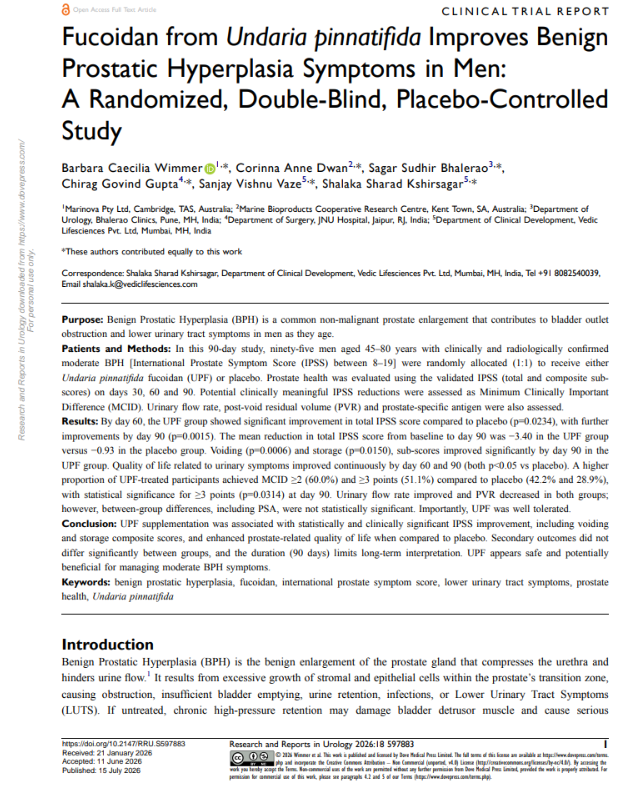
 Fucoidan from Undaria pinnatifida Improves Benign Prostatic Hyperplasia Symptoms in Men: A Randomized, Double-Blind, Placebo-Controlled Study

Published July 2026 

A newly published randomized, double-blind, placebo-controlled clinical trial has identified a promising natural approach for managing symptoms of Benign Prostatic Hyperplasia (BPH), a condition affecting millions of aging men worldwide. Researchers found that Undaria pinnatifida Fucoidan (UPF)—a highly purified polysaccharide extracted from brown seaweed—produced statistically and clinically significant improvements in urinary symptoms and quality of life after just 90 days of daily supplementation. 


breakthrough clinical study

The study enrolled 95 men aged 45–80 with moderate BPH and compared Undaria pinnatifida Fucoidan (UPF) with a placebo. By Day 90, participants receiving UPF experienced a 3.4-point reduction in the International Prostate Symptom Score (IPSS) compared with 0.93 points in the placebo group. Improvements were observed in both urinary storage symptoms, such as frequency and urgency, and voiding symptoms, including incomplete emptying, weak stream, and straining. Importantly, more than half (51.1%) of men taking Undaria pinnatifida Fucoidan (UPF) achieved a clinically meaningful improvement in symptoms, significantly outperforming the placebo group (28.9%). Participants also reported measurable improvements in quality of life related to urinary health. 

The treatment demonstrated an excellent safety profile, with only mild adverse events reported and no significant safety concerns identified during the study. While secondary measures such as urinary flow rate, post-void residual volume, and PSA did not differ significantly between groups, researchers emphasized that the study was specifically powered to evaluate symptom improvement rather than these secondary outcomes. 

The investigators concluded that Undaria pinnatifida Fucoidan (UPF) represents a promising, well-tolerated nutraceutical option for men with moderate BPH, while noting that larger and longer-term clinical trials are needed to further establish its role alongside conventional medical therapies. The findings were published in Research and Reports in Urology (2026) and represent one of the first randomized, placebo-controlled human studies demonstrating clinically meaningful improvements in BPH symptoms using purified Fucoidan derived from Undaria pinnatifida.

Latest Research Focus

Explore our comprehensive database of over 2,500 studies.

Colon Cancer

Fucoidan from Fucus vesiculosus inhibits the growth of HCT-15 human colon cancer cells by inducing apoptosis (cell death) through the activation of caspases, ERK, and p38, alongside the inhibition of the PI3K/Akt pathway [2, 3]. By decreasing anti-apoptotic Bcl-2 and increasing pro-apoptotic Bax, Fucoidan shows potential for colon cancer treatment. [3]
Immune Dysfunction

Fucoidan, a sulfated polysaccharide extracted from brown seaweeds, exhibits a wide range of bioactivities, including anticancer activity. As natural killer (NK) cells
serve an important
role in defenses against tumor cells,
the present studies examined the effects of Fucoidan extracted from Cladosiphon okamuranus
on NK cell activity in cancer survivors. [4]

Diabetes

Fucoidan is sulfated polysaccharide of brown seaweeds that may help to maintain glucose homeostasis by reducing the rate absorption of glucose from the intestine and increasing its utilization by muscle fibers as a nutraceutical for patients with diabetes mellitus. Fucoidan should be considered as
a functional food product for the prevention and treatment of diabetes mellitus. [5]
What is Fucoidan?

Fucoidan is a sulfated polysaccharide found mainly in various species of brown seaweeds such as Mozuku, Mekabu, and Fucus (Bladderwrack).


Scientifically recognized for its high molecular weight and complex structure, Fucoidan has been the subject of extensive research investigating its potential bioactivities.

Types of Seaweeds

Advanced Extraction Processes

It was found that one species of brown algae could produce several types of Fucoidan differing in their fucose, aldose, uronic acids, acetyl groups and sulfate content. 


Other studies have reported the extraction of four types of fucoidan from different species, which showed different antioxidant activity, depending on sulfate content and monosaccharide composition. The polysaccharide sulfate content and degree of sulfation may vary among species, and it is highly dependent on the season of harvest. [6]

Fucoidan AI Assistant

Hello! I am Fucoidan AI. I provide research-backed info on Fucoidan studies. How can I help you today?
AI is thinking...
Engineered by Syed Ahmar Ali
Scroll to Top

Disclaimer

The information provided on this website is for educational and informational purposes only and is not intended as medical advice. Fucoidan Research does not diagnose, treat, cure, or prevent any disease. Always consult with a qualified healthcare professional before beginning any new supplement regimen, especially if you are currently undergoing medical treatment.